Empowering a Gas & Electric Utility Provider to Strengthen PMO Maturity and Reduce Project Risk
Background:
In today’s utility sector, capital projects are under increasing pressure. Aging infrastructure, regulatory complexity, and rising stakeholder expectations make it harder than ever to deliver capital projects on time and within budget. At Clarisight Consulting (Clarisight), we help utility leaders navigate these challenges by transforming their project controls and PMO capabilities through structured, data-driven strategies.
The Challenge: Fragmented Controls, Rising Risk
A utility provider in Hydro Power Genewas grappling with persistent cost overruns, schedule delays, and inconsistent execution. While their project controls were formally established, they remained siloed—limiting collaboration and real-time responsiveness. Project schedules were treated as static reporting tools rather than dynamic management instruments, resulting in misalignment, operational inefficiencies, and a reactive approach to decision-making.
Key challenges included:
- Inaccurate estimates due to lack of historical project data.
- Schedules used as static reports rather than dynamic management tools.
- Frequent budget overruns and ineffective long-term budget planning.
- Frequent reauthorization due to inefficient change control process.

Our Solution: The Project Controls Assessment Roadmap (PCAR)
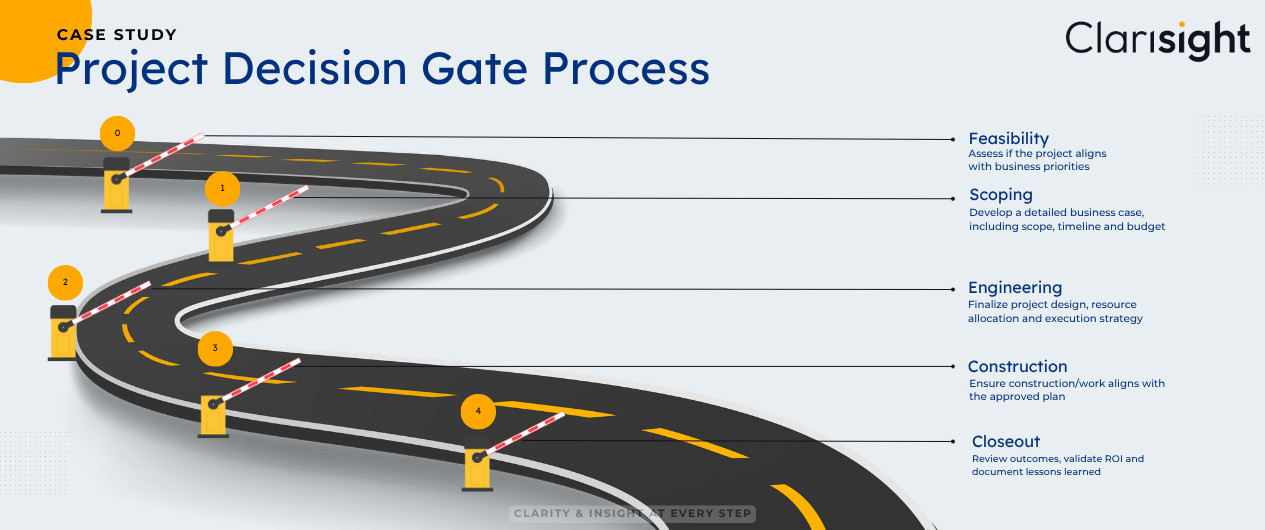
To address these challenges, Clarisight deployed our proprietary Project Controls Assessment Roadmap (PCAR) — a three phased framework designed to assess, benchmark and elevate PMO maturity:

The Process: From Assessment to Action
We began with a Current State Assessment, engaging project managers, project controls team, and PMO leadership to identify pain points and evaluate tools and processes. Using industry benchmarks, we scored maturity across eight critical domains.
- Scope Management: Evaluated scope definition, WBS, design milestones, and change control.
- Cost Management: Reviewed estimation, budgeting, EVM, contingency tracking, and variance reporting.
- Schedule Management: Assessed scheduling tools, baseline control, and milestone tracking.
- Integration Management: Evaluated delivery systems, RACI documentation, and phase gate reviews.
- Change Control: Assessed deviation from baseline, templates, DOA approvals, and change logs.
- Risk Management: Reviewed risk identification, mitigation, and integration with cost/schedule controls.
- Communication Management: Evaluated communication plans, status reporting, and stakeholder engagement.
- Procurement Management: Reviewed contracting strategy and supplier performance monitoring tools.
We then developed a data-driven action plan with measurable steps, implemented through pilot projects that validated improvements, trained internal teams, and established a foundation for continuous monitoring and optimization.
The Outcome: A Stronger PMO
- Improved project predictability using historical estimate benchmarking.
- Reduced cost and schedule variances through EVM implementation.
- Stronger cross-departmental alignment via a formal change control board.
Conclusion
By embedding best practices and fostering a culture of continuous improvement, Clarisight helped the client evolve from reactive project management to a proactive, insight-driven PMO.
Ready to elevate your delivery capabilities? Contact us at info@clarisight.com to explore how we can help you transform your project challenges into strategic opportunities.